My Repetition Check Caught Zero of 22 Repeats
A quality check that looked fine on paper, the $7 experiment that proved it wasn't, and why I now let a model read while I check.
DailyChew makes one personalized audio episode for each listener every morning. Reed, the narrator, gets to know you over time. That only works if he doesn't repeat himself. A friend who tells you the same story twice in a week is a friend you start half listening to.
So early on I built a check. Before an episode ships, it gets compared to the listener's recent episodes, and if it's too similar, the pipeline sends it back to be rewritten. It's a standard approach: turn each script into an embedding (a long list of numbers that represents what the text is about), measure how close two scripts are, and block anything above a threshold. Mine was 0.92 on a scale where 1.0 means identical.
It looked fine. It never fired in a way that seemed wrong. Then, every so often, an episode would retell a story from a few days earlier, and the check let it through every time.
The check had never been tested
When I went to find out why, I discovered something embarrassing. The 0.92 threshold was supposed to have been tuned against labeled examples of repeats. Those labels never existed. The labeling pass had been planned and never run. The number was a guess that had been written down in enough places to look like a fact.
So the first job wasn't fixing the check. It was finding out whether it worked at all, which meant I needed real examples of repeats.
I tried grading by hand. It was too slow.
The obvious way to get labels is to read pairs of episodes and mark which ones repeat. I tried. An episode script is long, and a repeat is often one 90-second passage inside ten minutes of new material. Reading two whole scripts side by side to find that passage is slow, careful work, and I have 10 to 15 hours a week for this entire company.
I wrote down a rule for myself that I've used ever since: a model should read, and I should check.
The $7 experiment
I set up a model grader. It read 200 pairs of recent episodes and, for each pair, answered one question: does the second episode retell something from the first? If it said yes, it had to quote the passage from each script. Every quote was then verified against the actual scripts automatically, so the grader couldn't invent evidence. All 200 sets of quotes checked out.
The run cost $7.17.
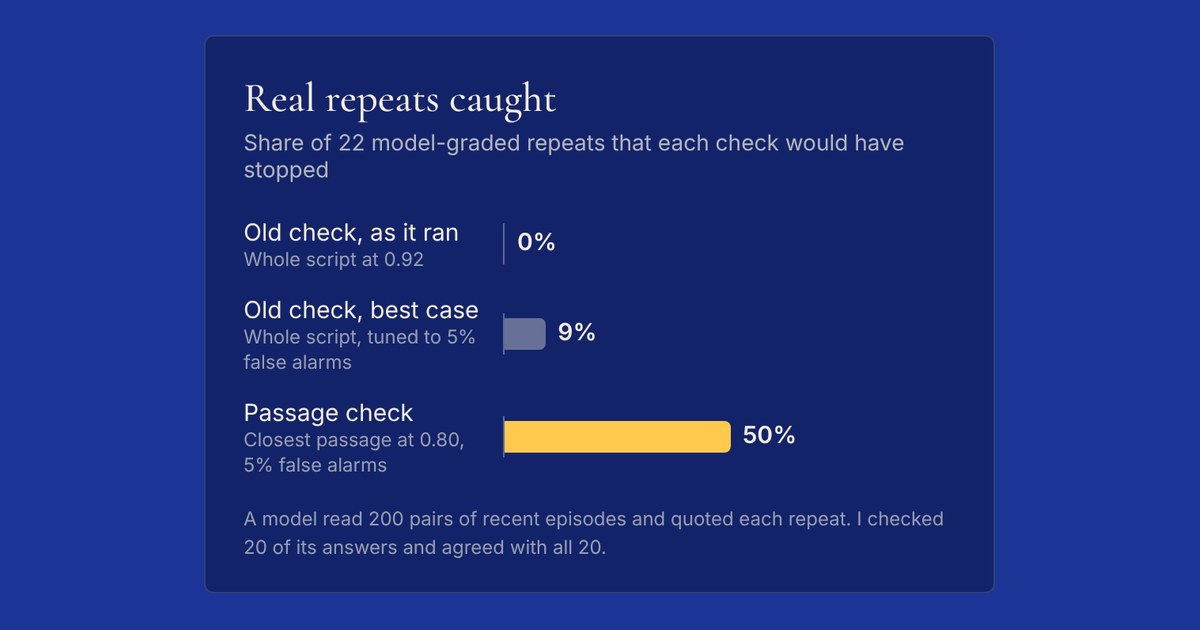
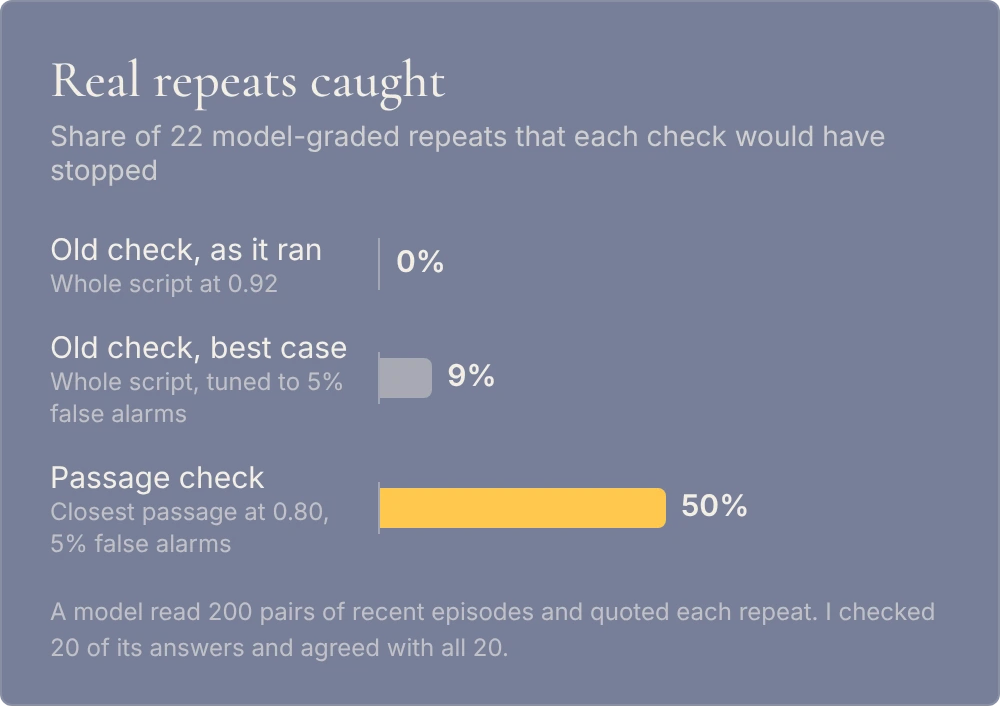
The grader found 22 repeats. The live check, at 0.92, had caught zero of them.
Then I checked the grader. I built a small review page that put the two matched passages side by side, with the model's answer already selected, so confirming a pair took one tap. I went through 20 of them. I agreed with the model on all 20.
Why the whole-script check missed everything
Once I could see the repeats, the reason was obvious. An embedding of a whole script is an average of everything in it. If one passage out of six is a retold story and the other five are new, the average barely moves. Two episodes can share a story and still look like two different episodes, because mostly they are.
Here's a made-up example of the shape. Monday's episode includes a two-minute story about a city that painted its roofs white to cool its streets. Thursday's episode is about urban heat, a book recommendation, and your week ahead, and somewhere in the middle it tells the white-roofs story again. As whole documents, Monday and Thursday are different. As passages, one pair of them is nearly the same.
The fix: compare passages, not episodes
The new check splits each script into passages of about 180 words and compares every passage to every passage in recent episodes. If the closest pair is above 0.80, the episode goes back to be rewritten with a new story.
Against the graded pairs, the difference was large. At a setting where each check wrongly flags about 5% of fine episodes, the whole-script check catches 9% of real repeats. The passage check catches 50%. Measured another way (how well each one separates repeats from non-repeats overall), the whole-script check scored 0.70 and the passage check 0.82, where 0.5 is a coin flip and 1.0 is perfect.
Half isn't everything, and I want to be honest about that. The sample is small, and these numbers will move as more episodes come in. But going from catching nothing to catching half is the difference between a check that exists and a check that works.
How it rolled out
I didn't turn it on for everyone at once. It ran first on my own account and in the Pipeline Lab, where I test the pipeline on synthetic listeners. It ran across a batch of test episodes without a single false alarm. As of this Sunday's release it runs for every listener, and I'll be watching how often it fires in the first week.
What I took from it
Three things I'd tell anyone building quality checks on top of language models:
- A threshold you never tested is a guess. Write down where every number came from. If the answer is "we planned to tune it," it isn't tuned.
- Match the check to the failure. The failure was one retold passage, not a repeated episode. The check should have looked at the same unit the problem lives in.
- Let the model read, and you check. I couldn't afford to grade 200 long scripts. I could afford $7 and twenty taps. The quote-verification step is what made trusting the model reasonable: it had to show its work, and its work was checked by code before it reached me.
The next thing I'm working on is the other kind of repetition, where Reed tells a new story but tells it the same way every time. That one is about structure, not content, and I don't think an embedding will catch it.